
Luxon Promises India $34 billion Investment & ~20% of All Indian Skilled Visas
At 1/7th the trade value of the EU, primary industry benefits, but what are the fish hooks in the India-New Zealand trade deal signed by Luxon?
Quick Facts
- Luxon’s trade deal agreement with India has been praised by commentators such as 1News’ Jason Walls and The Post’s Luke Malpass
- The deal is valued at 1/7th of the historic EU deal signed in 2022 under Labour/Green, which came into effect in 2024.
- The NZ-India deal includes a “clawback” if NZ fails to honour its promise to directly invest $34 billion in India’s businesses and economy over 15 years
- And a closer look at the $34 billion promise and signed deal reveals fish hooks for Aotearoa New Zealand too
- Explainer herein includes comparisons to other deals e.g. the UK-India trade deal which provided zero concessions for immigration and the EU-India trade deal which offered significantly less investment commitments
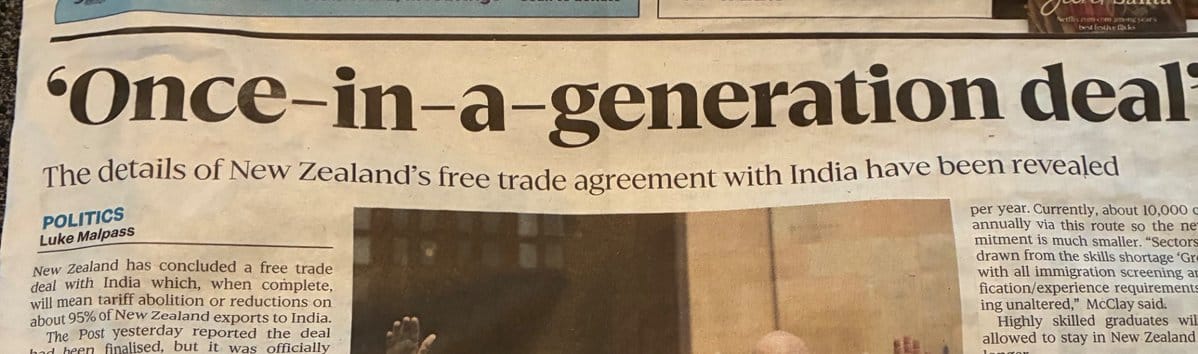
As reported here yesterday, Luxon’s free trade deal with India has been touted by The Post’s Luke Malpass as a “once in a generation” deal — which only leads one to wonder where Malpass has been his entire life.
Perhaps Malpass overlooked the $22 billion trade deal secured by New Zealand in 2022 - 7 times that of the Indian deal and helping grow NZ exports by $2 billion a year
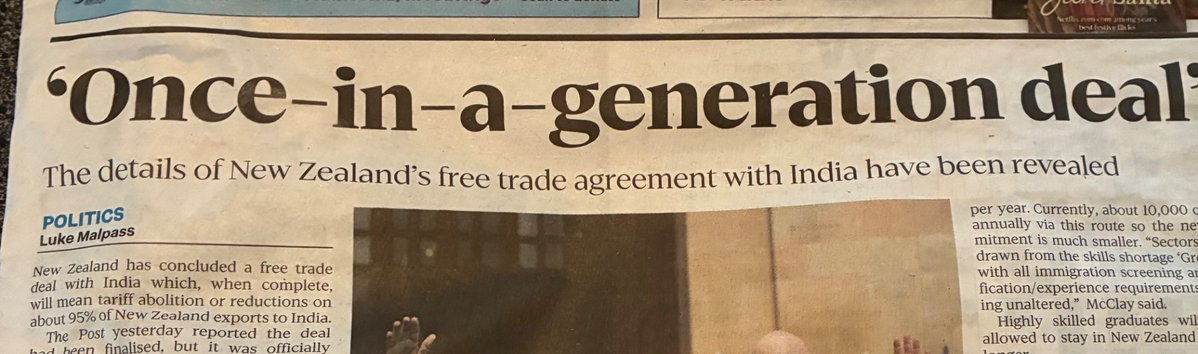
Over on TVNZ’s 1News, NZME’s ex political editor Jason Walls was similarly breathless, informing Kiwis that the deal was as good as to be expected, and interviewing Zespri Kiwifruit’s CEO, who said the FTA would be worth $9 million a year for them.
(To put this in perspective, $9 million is 1/222 of what the EU export value was estimated at. Other winners in NZ’s India FTA deal include lamb, wool, coal, forestry and apples)
But look closer, and it becomes clear that caution is warranted.
In India, their press celebrated the FTA as a clear win, citing a “$20 billion dollar investment boost for India and zero-duty access” for their exporters.
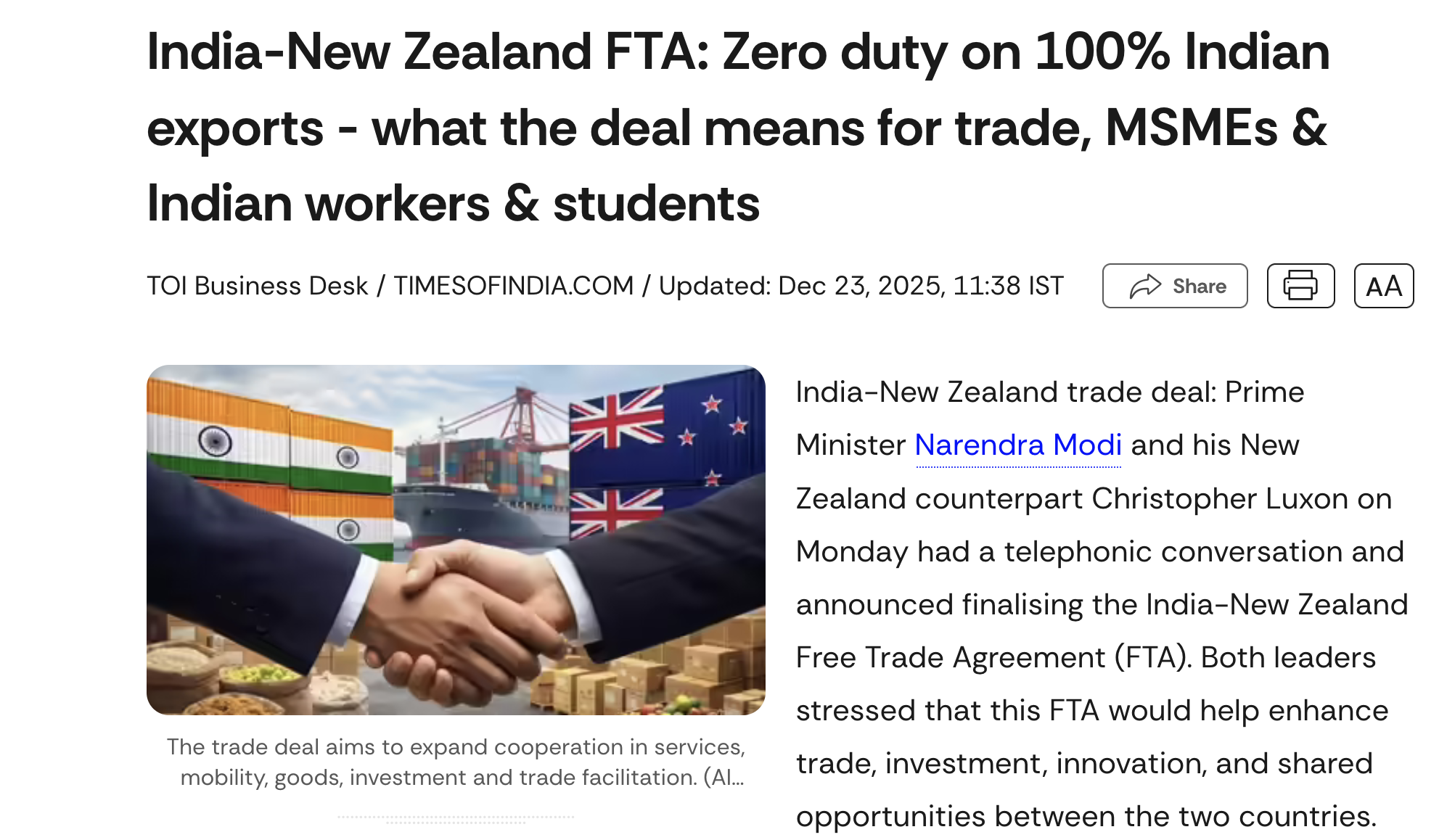
CNBC confirmed it as well:
The pacific island nation will invest $20 billion in India over next 15 years and allow mobility of professionals, skilled labor and students from India to New Zealand
If you’re wondering how that translates, it means New Zealand is committing to invest / spend NZ $34 billion (US $20 billion) to support India’s economy and growth - as well as significantly broadening our immigration channels.
That $34 billion ($34 thousand million dollars) over 15 years disallows institutional investors and portfolio investment, meaning New Zealand businesses will be expected to stump up to directly invest in India
Luxon has given other concessions in the deal- for example, he has signed the first ever NZ acknowledgement for Indian traditional medicine and health services.
India’s deal reduces tariffs on a range of Kiwi products e.g. wool, kiwi fruit, apples and lamb but excludes any concessions for: Dairy, coffee, milk, cream, cheese, yoghurts, whey, caseins, onions, sugar, spices, edible oils, rubber.
Emeritus Professor Jane Kelsey, who has closely followed trade negotiation with India over the years, issued the following caveat upon the deal’s announcement:
“When the Prime Minister announced he would secure a free trade agreement (FTA) with India during the term of this government he scored another own goal.
India, with whom New Zealand had spent many previous years in futile negotiations for a FTA, knew it could simply dictate the terms to a government desperate for a political trophy.
“Today’s announcement that a worthwhile deal has been sealed in just eight months and a handful of negotiating rounds, needs to be taken with a sack of salt”…
“There is no public text and very little information has been released throughout the short negotiation. So, there is no way to independently assess the government’s claims. Nor do we know that India will actually see agreement this through to ratification and implementation.”
Kelsey added further context when she lamented media coverage, writing in a comments section:
“The UK and India, the world’s 5th and 6th largest economies, concluded a FTA in July 2025 after three and a half years and 15 rounds of negotiations..
The UK’s own impact assessment predicts a derisory increase to its gross GDP of 0.13%, or £4.8 billion “in the long run”, with 0.06% or £45.1 billion for India.
So let’s stop the hype, see the actual text, and have an evidence-based public debate and engagement on these deals, before any further negotiations are launched that sink scarce public resources into what have become little more than political notches on the government’s belt.”
Professor Kelsey’s right, of course.
Amidst a largely breathless media, Business Desk’s Dileepa Fonseka revealed that a clause in the deal allows India to claw back all trade concessions if New Zealand fails to invest $34 billion in India.
India’s Government explained it in this way:
“New Zealand has committed to facilitate investments of USD 20 billion into India over the next fifteen years, thereby supporting manufacturing, infrastructure, services, innovation and employment under India’s Make in India vision.”
Any forecast this is not met will be met with a ‘rebalancing mechanism’ .
India’s Commerce and Industry Minister also emphasised the USD 20 billion foreign direct investment (FDI) investment would exclude institutional investors (FII)/foreign portfolios (FPI):
“We will get a long term sustainable capital. FPI and FIIs are not included in the USD 20 billion investment commitment.”
Meaning NZ’s investment is expected to be direct and involved.
Thanks for reading! This post is public to here so feel free to share.
Article continues below for paid subscribers