What Do Chris Bishop's Road User Charges (RUC) Mean?
Bishop's masterful levels of control and influence

Bishop’s Control

Chris Bishop is fairly masterful at government announcements.
He has a knack for maximum narrative control, strategic PR, and always proffers a range of voluminuous information that means media find it hard to dissect quickly.
Therefore, what gets reported in the initial headlines is largely Bishop verbatim.
It was the same with Kāinga Ora - he was able to influence the majority of headlines in mainstream media to lay a trail of breadcrumbs supporting his narrative i.e. that KO was “financially unsustainable”
This is categorically untrue, as I reported on last year, well before Bishop’s final announcement - when I correctly pre-empted his moves, and the outcome of Bill English’s $500,000 report.
Ultimately, Bishop’s Kāinga Ora “turnaround plan” was substantively cutting state housing by stealth, selling off land to private developers, and increasing homelessness.1
But it never hit the headlines that way.
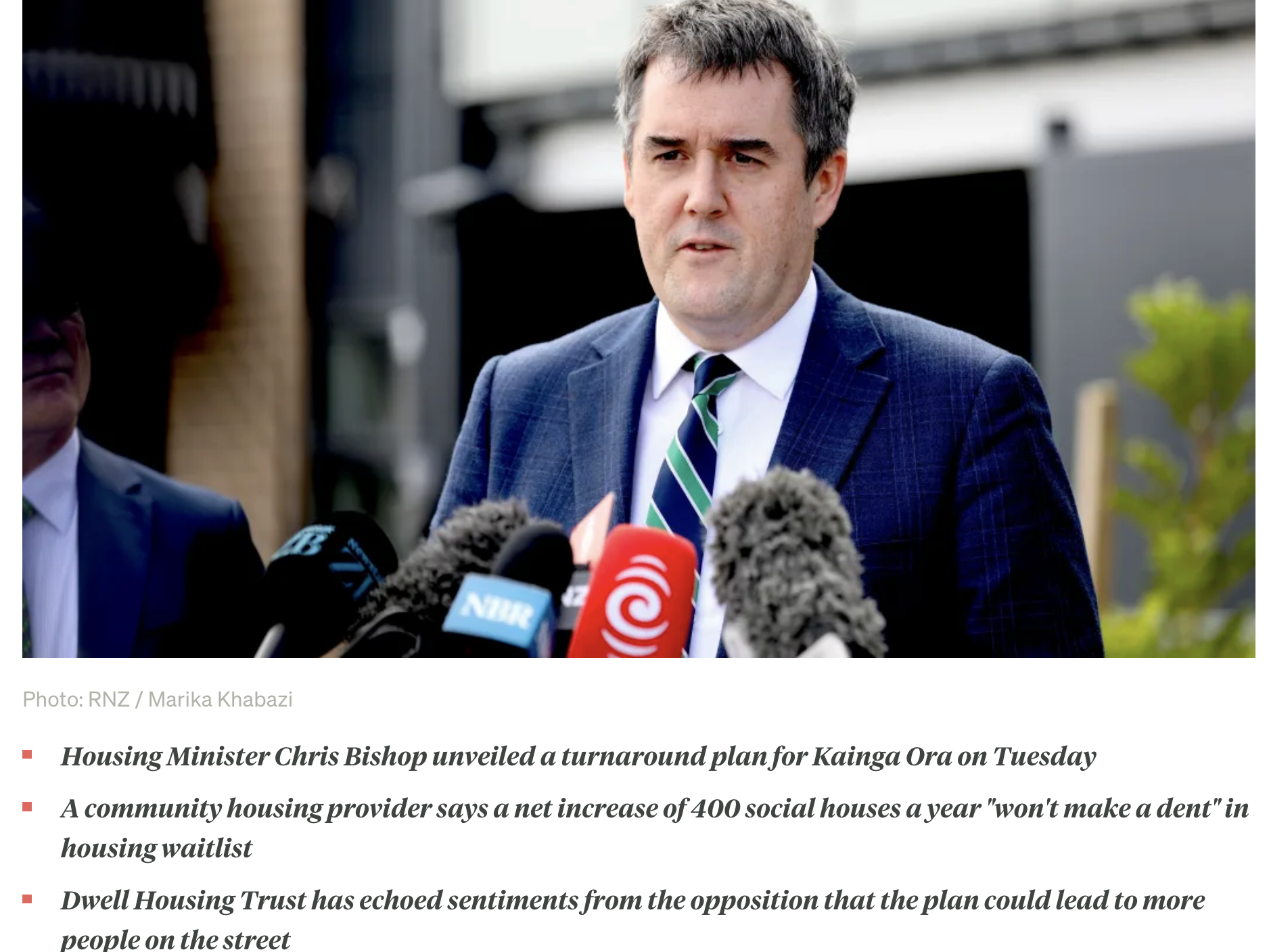
Bishop’s Kāinga Ora plan amounts to a net increase of 400 social houses a year, while 20,000 plus languish on the public housing register
What’s Bishop doing with the RUCs then?
On Road User Charges, it’s been billed as some of the most significant reforms in recent history.
But among all of that, my quick, early summation was four fold:
- It’s an assist to the fossil fuel industry,
- It penalises fuel efficient vehicles and thereby our environment,
- Poses privacy/data protection concerns with electronic GPS / RUC device monitoring,
- And it benefits private corporations